
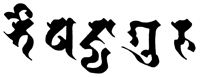
bhai ṣa jya gu ru
Bhaiṣajyaguru the medicine Buddha is a slightly enigmatic figure. His mythology goes back to early Buddhism, but his origins are obscure, being perhaps related to texts where the historical Buddha is described as a physician come to cure the ills of the world. Bhaiṣajyarāja is the name of a Bodhisattva in the Saddharma Puṇḍarīka or White Lotus Sūtra who immolates himself as an offering to the Buddha.
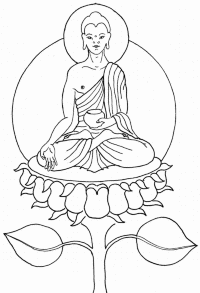
He is depicted as deep blue in colour, dressed in bhikṣu's robes, holding his begging bowl in his left hand and with his right hand making the varada mudra. Varada means 'granting wishes, conferring a boon, ready to fulfil requests or answer prayers'. Sometimes, especially in East Asian iconography, the begging bowl is replaced by a medicine jar; in Tibetan images a myrobalan plant, thought to be a panacea, grows out of the bowl
Mantra
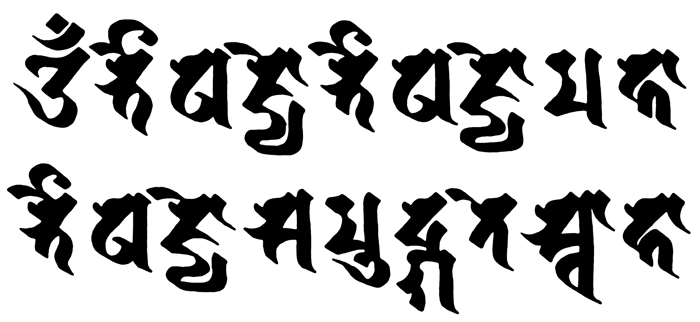
Transliteration
oṃ bhai ṣa jye bhai ṣa jye ma hā
bhai ṣa jya sa mu dga te svā hā
oṃ bhaiṣajye bhaiṣajye mahābhaiṣajya-samudgate svāhā
ओं भैषज्ये भैषज्ये महाभैषज्यसमुद्गते स्वाहा |
Tibetan
Sanskrit Spelling

Tibetan Spelling and Pronunciation

There seems to be a great deal of variation of the romanisation of this mantra. This uchen script version is the same Tibetan spelling as on Andy Weber's post card - so should be authorative. This would Romanise literally as:
oṃ bhe ṣa dzye bhe ṣa dzye ma hā bhe ṣa dzye rā dza ye sa mu dga te svā hā
Note the bhaiṣajyarāja one of many variations. However the pronounciation is something like:
om beh ka dze-yah beh ka dze-yah ma ha beh ka dze-yah la dza sah mo kyah deh sowa ha
Notes
There are many variations on this mantra, and some other mantras and dhāraṇī associated with Bhaiṣajyarāja. In Sanskrit bhaiṣajya can mean: curativeness, healing efficacy; a ceremony performed as a remedy for sickness; any remedy, drug or medicine; the administering of medicines. Guru is teacher. The word svāhā comes from Vedic ritual.
For more information on this mantra on Bhaiṣajyaguru and his mantra see the Wildmind Bhaiṣajyaguru page
This mantra can be found the Sūtra of the Medicine Buddha [pdf file] (Taisho XIV, 450) where it is described as a great dhāraṇī. In the sūtra the mantra is introduced by the words:
namo bhagavate bhaiṣajyaguru vaiḍūryaprabharājāya tathāgatāya arhate samyaksambuddhāya tadyathā
homage to the blessed medicinal teacher, to the king of jewel-like radiance, to the one who is like that, the worthy, the fully awakened one, thus:
In Siddhaṃ this looks like:
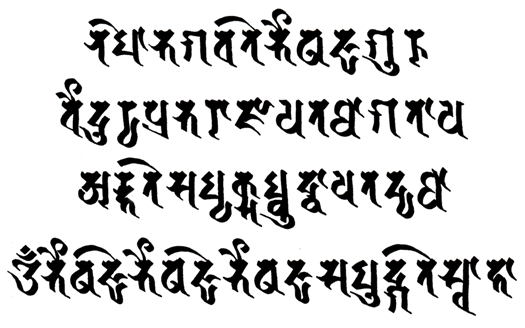
namo bhagavate bhaiṣajyaguru
vaiḍūryaprabharājāya tathāgatāya
arhate samyaksambuddhāya tadyathā
oṃ bhaiṣajye bhaiṣajye mahābhaiṣajya samudgate svāhā
नमो भगवते भैषज्यगुरु
वैडूर्यप्रभराजाय तथागताय
अर्हते सम्यक्सम्बुद्धाय तद्यथा
ओं भैषज्ये भैषज्ये महाभैषज्यसमुद्गते स्वाहा
The book of the
Visible Mantra Website
now on sale

Meeting the Buddhas
by
Dharmacari Vessantara

on Amazon US
Or Amazon UK
Last updated: 11:43 06/02/2009